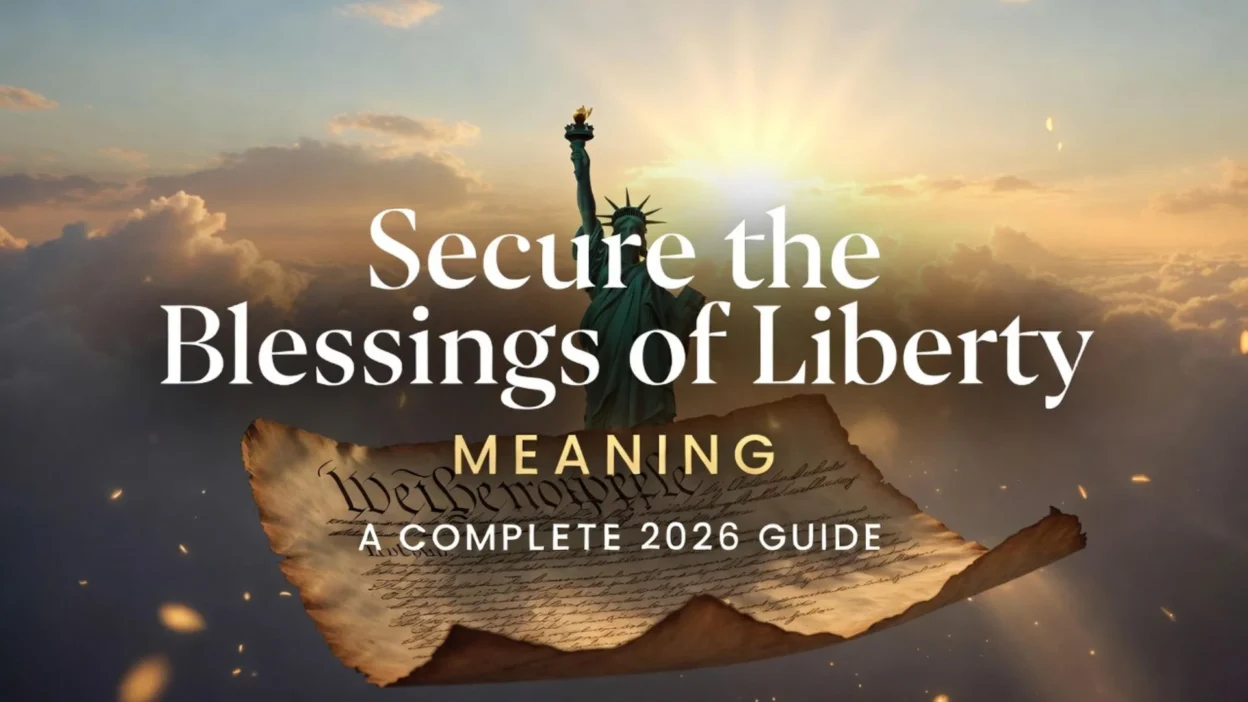
Have you ever stopped to wonder what it truly means to be free? Not just free in a casual, everyday sense — but free in a way that is protected, lasting, and guaranteed by law? The phrase secure the blessings of liberty meaning answers exactly that question. It comes from the Preamble of the United States Constitution, written in 1787, and it remains one of the most powerful promises any government has ever made to its people. In 2026, as debates about digital rights, civil liberties, and government power continue to shape the world, this phrase feels more alive and urgent than ever. Throughout this complete guide, you will discover what this phrase means word by word, why the Founders wrote it, how courts protect it today, and what responsibility it places on every generation — including ours.
What Is the Full Preamble to the US Constitution?
To understand the secure the blessings of liberty meaning, you first need to know where it comes from. The full Preamble reads:
We the People of the United States, in Order to form a more perfect Union, establish Justice, insure domestic Tranquility, provide for the common defence, promote the general Welfare, and secure the Blessings of Liberty to ourselves and our Posterity, do ordain and establish this Constitution for the United States of America.
These 52 words introduce the entire Constitution. They explain why this document was written and set the tone for everything that follows. The Preamble describes the purposes behind the enactment of America’s charter of government. It tells citizens what their government exists to achieve.
Among all the goals listed in these words, securing the blessings of liberty stands out as the most personal. Furthermore, it speaks directly to the lived experience of every human being. It is not about borders or armies or economics alone. Instead, it is about the right of every person to live freely, safely, and with dignity. That is why this phrase still matters deeply in 2026.
Secure the Blessings of Liberty Meaning: A Word-by-Word Breakdown
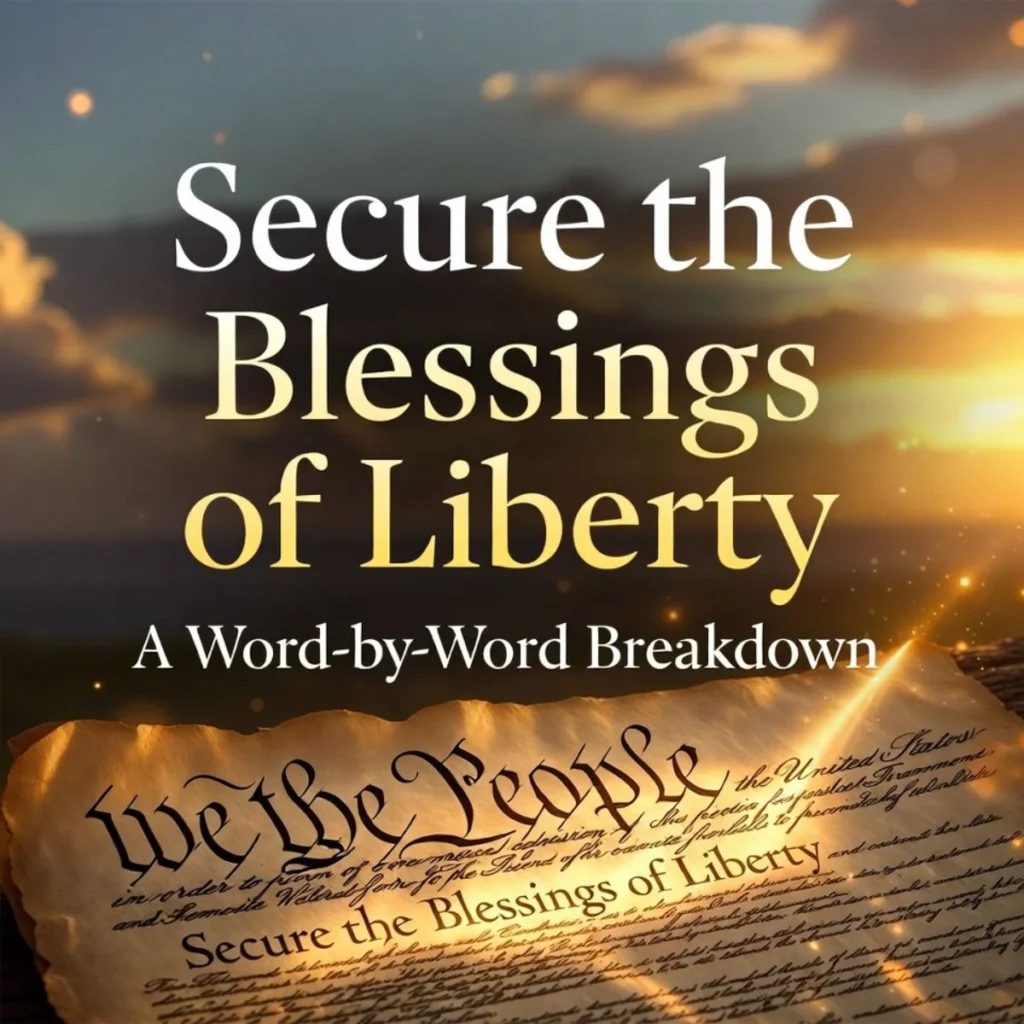
To truly understand this phrase, you need to examine each part carefully. Therefore, let us break it down word by word.
What Does “Secure” Mean?
The word “secure” is an active verb. It does not mean simply to have something. Rather, it means to get it, hold onto it, and build systems that protect it from every possible threat.
Gouverneur Morris, the primary author of the Preamble, could have simply written “and secure liberty.” However, he carefully chose to write “the blessings of liberty.” He meant that formal liberty alone was insufficient. Moreover, the government must achieve the actual, real, practical benefits of freedom in everyday life. Declaring freedom is not enough. Consequently, in 2026, securing liberty also means protecting digital rights, voting access, and equal treatment under modern law.
What Are the “Blessings of Liberty”?
The word “blessings” carries deep meaning. A blessing is a gift — something valuable, something to be cherished and actively protected. The blessings of liberty include freedom of speech and religion, equal access to justice, the rule of law, economic opportunity, and personal safety.
Additionally, these blessings connect directly to the principles of the Declaration of Independence — that all people are created equal and endowed with the unalienable rights of life, liberty, and the pursuit of happiness. In 2026, the blessings of liberty also extend to newer freedoms. For example, the right to online privacy, the right to access information freely, and the right to equal treatment regardless of background are all modern blessings that every generation must actively guard.
What Does “To Ourselves” Mean?
“To ourselves” refers to the people living at the time the Constitution was created. It makes an immediate, personal commitment to real citizens facing real problems. This matters greatly because it shows that liberty is not a distant ideal. Specifically, it must be felt and experienced here and now — not just promised on paper but delivered in practice.
What Does “Our Posterity” Mean?
The word “posterity” signals a long-term commitment rather than a short-term political bargain. Posterity means all future generations — your children, their children, and every person who will ever live in this nation. Consequently, this single word transforms the Constitution from a document of its time into a living promise across centuries. Every generation must therefore work to protect liberty, pass it on, and improve it. It is a shared duty that never ends.
The Historical Background: Why Did This Phrase Matter in 1787?
The Founders did not write these words from a position of comfort. Instead, they wrote them after decades of living under British rule that had systematically stripped them of their rights. Taxes were imposed without consent. People faced arrest without fair trials. Soldiers occupied private homes by force. As a result, liberty became deeply personal to every man who signed the Constitution.
The Founders clearly understood that liberty was fragile. History had shown them how easily governments erode freedom through tyranny and neglect. Additionally, they remembered the failures of the Articles of Confederation — the first national government that proved too weak to protect rights or maintain order.
Therefore, the new Constitution had to solve both problems at once. It needed to create a government strong enough to protect freedom, yet limited enough to never itself threaten that freedom. Through the separation of powers and the system of checks and balances, the three branches of government share authority. This structure prevents exploitation and secures equal rights within a stable constitutional government. That balance remains the foundation of American democracy in 2026.
Who Wrote These Words? The Man Behind the Preamble
Gouverneur Morris of Pennsylvania is the primary author of the Preamble. He wrote it during the final days of the Constitutional Convention in September 1787. Morris was also one of the most gifted writers among all the Founders.
He carefully specified the need to secure “the blessings of liberty for our posterity,” meaning the Constitution must protect the benefits of liberty for future generations — not just the first, nor any particular subsequent one. Moreover, Morris understood something profound. Writing down rights is not the same as protecting them. A constitution is only as strong as the institutions, habits, and culture that support it. Therefore, he was not merely writing a legal document. He was laying the foundation for a way of life.
The Blessings of Liberty in the Bill of Rights
The most concrete expression of the secure the blessings of liberty meaning appears in the Bill of Rights — the first ten amendments to the Constitution, ratified in 1791. Over more than two centuries, the Bill of Rights transformed American life and established a lasting culture of rights and liberties as a bulwark against government power.
Each amendment protects a specific blessing of liberty:
- First Amendment — Freedom of speech, religion, press, and peaceful assembly
- Second Amendment — The right to bear arms as protection against tyranny
- Fourth Amendment — Protection from unreasonable searches and seizures
- Fifth Amendment — Protection from self-incrimination and double jeopardy
- Sixth Amendment — The right to a speedy and fair public trial
- Seventh Amendment — The right to a jury trial in civil cases
- Eighth Amendment — Protection from cruel and unusual punishment
- Ninth Amendment — Rights not listed still belong to the people
- Tenth Amendment — Powers not delegated to the federal government remain with states and citizens
Together, these amendments transform the promise of the Preamble into enforceable law. They are not abstract ideals. Instead, they are real protections that shape your daily life in 2026.
The Legal Meaning: What Do Courts Say About This Phrase?
The Preamble’s statements of purpose do not themselves grant powers or confer rights. Instead, the substantive provisions in the main body of the Constitution do that. However, this does not mean the phrase carries no legal importance.
Courts have used the Preamble as a powerful interpretive guide for over 230 years. When judges face two possible interpretations of a law, they often turn to the Preamble for direction. Furthermore, the purposes behind the Constitution — to establish justice, ensure domestic tranquility, and secure the blessings of liberty — embody the aspirations that the people have for their government. These aspirations guide major legal decisions every year.
In 2026, this interpretive role grows increasingly important. Courts now regularly use the spirit of the Preamble to evaluate laws about digital privacy, free speech on social media, and voting rights protections. Consequently, this 235-year-old phrase actively shapes modern American law.
Liberty and Justice: Two Ideas That Cannot Be Separated
The Preamble lists both liberty and justice as goals. This connection is not accidental. Rather, the two ideas depend entirely on each other.
Liberty and justice are deeply connected partners. One cannot stand strong without the other. Furthermore, freedom loses its meaning when fairness disappears, and justice cannot thrive where liberty is restricted. In American constitutional law, justice requires both fair procedures and adequate reasons whenever the government affects a person’s life, liberty, or property.
Think about what this means in everyday life. If you are free but courts are corrupt, your freedom means nothing. Alternatively, if courts exist but citizens have no freedom, justice becomes a weapon of control. Only when both liberty and justice exist together can a society truly flourish and grow.
“Blessings” — The Spiritual and Moral Dimension of Liberty
The word “blessings” is not ordinary political language. Instead, it carries deep spiritual weight. In many religious traditions, a blessing comes from a higher power — something sacred, something to be treated with reverence and genuine gratitude.
The American Founders recognized that human beings possess certain unalienable rights given by their Creator. Constitutional government exists specifically to secure and protect those natural rights — the blessings of liberty enshrined in the Declaration of Independence. By calling liberty a “blessing,” the Founders elevated it above ordinary politics. They declared it sacred, worthy of sacrifice, and something no government should ever treat carelessly.
For people of faith in 2026, this spiritual connection remains powerful and deeply personal. The right to worship freely is a blessing. Similarly, the right to raise your family according to your values is a blessing. The right to speak your conscience without fear is also a blessing. These are gifts that free societies must actively protect and never take for granted.
Secure the Blessings of Liberty in 2026: Modern Challenges
The work of securing liberty never ends. In 2026, however, new challenges demand new attention and active citizen engagement.
Digital Privacy and Online Freedom
The right to privacy online is one of the most debated liberty issues in 2026. Governments and corporations collect enormous amounts of personal data every single day. Therefore, citizens must ask: does this surveillance genuinely protect us, or does it quietly erode our freedom?
Ensuring the blessings of liberty in our digital world requires constant vigilance from all citizens. Furthermore, lawmakers must balance national security needs against the right to personal privacy. The secure the blessings of liberty meaning demands that policymakers take these tensions seriously rather than dismissing them.
Voting Rights and Political Participation
The right to vote is one of the most fundamental blessings of liberty. However, access to voting continues to be debated across the United States. In 2026, ensuring that every eligible citizen can vote freely and fairly remains one of the most critical ways to secure the blessings of liberty for the present generation.
When voting rights face restriction or undermining, the ability of citizens to shape their own government weakens. Consequently, when citizens cannot shape their government, the entire system of self-governance that the Founders built begins to erode.
Economic Freedom and Opportunity
Economic freedom also forms a core blessing of liberty. The right to work, build a business, and keep the fruits of your own labor are all essential blessings. Moreover, protecting economic liberty has always required careful balancing between individual freedom and shared responsibility.
In 2026, debates about economic inequality, workers’ rights, and corporate power all connect directly to this question. Are the blessings of economic liberty available to all Americans? Or do they primarily benefit the privileged few? These are questions that every generation must honestly answer.
Equal Rights for All Citizens
For much of American history, the blessings of liberty were unfairly denied to large portions of the population. Enslaved people, women, immigrants, and minority communities were systematically excluded from the freedoms promised in the Preamble. Therefore, the ongoing work of civil rights is the ongoing work of securing liberty. Every generation carries a responsibility to expand who genuinely enjoys the blessings of freedom.
The Responsibility of Every Generation
The phrase “to ourselves and our Posterity” creates a clear and lasting obligation. Every generation receives the blessings of liberty as an inherited gift. However, every generation also carries a duty to protect those blessings and pass them on stronger than they were received.
This phrase is more than a historical line from the Constitution. Instead, it is a direct call to action. It asks every citizen to protect the freedoms that shape their lives and actively pass them on to future generations. Liberty is not given once and maintained automatically. Rather, it is earned and protected daily — through fairness, political participation, and deep respect for the rights of others.
In practical terms in 2026, this means staying informed about laws and policies that affect your freedoms. Additionally, it means participating in elections, speaking up when rights face threats, and raising the next generation with a genuine appreciation for what liberty truly means and costs.
Frequently Asked Questions About Secure the Blessings of Liberty Meaning
What does secure the blessings of liberty meaning in simple words?
It means the government must actively protect the real, practical benefits of freedom — including speech, religion, fair trials, and equal rights — for every person alive today and for every future generation. Declaring freedom is not enough. Therefore, it must be built into laws, courts, and institutions that work every single day.
Is the Preamble legally enforceable?
No, the Preamble is not legally enforceable on its own. It introduces the Constitution but does not itself grant rights or government powers. However, courts use it as an important guide when interpreting constitutional provisions and deciding how laws should apply in real cases.
Who wrote the phrase “secure the Blessings of Liberty”?
Gouverneur Morris of Pennsylvania wrote the Preamble, including this phrase, during the final days of the Constitutional Convention in September 1787. He served as the primary author of the Preamble’s final draft.
What are the main blessings of liberty in 2026?
In 2026, the blessings of liberty include freedom of speech, freedom of religion, the right to vote, digital privacy, the right to a fair trial, economic opportunity, equal treatment under the law, and protection from government abuse of power.
What does “posterity” mean in the Preamble?
Posterity means all future generations — your children, grandchildren, and every person who will ever live in this nation. The Founders specifically wanted the blessings of liberty to last not just for their time but for all time to come.
How can ordinary citizens help secure the blessings of liberty today?
Citizens can help by voting regularly, staying informed about current laws, supporting fair policies, speaking up against injustice, and teaching the next generation to value freedom. Liberty is not maintained by governments alone. Instead, it requires active and ongoing participation from every citizen every day.
Conclusion: A Promise That Belongs to Every Generation
The secure the blessings of liberty meaning is simple at its heart. Freedom is a blessing. Therefore, it must be actively protected and passed on to every future generation stronger than it was received.
Understanding this phrase helps you see why freedom remains central to American life even in 2026. It reflects a promise that government exists to protect constitutional rights, civil liberties, and individual freedom — while maintaining order through the rule of law. The threats to liberty have certainly changed over time — from colonial tyranny to digital surveillance, from taxation without representation to algorithmic bias. However, the fundamental challenge remains exactly the same.
How do we build and maintain systems that protect the blessings of freedom for every person, in every era, without exception? Liberty is like a garden. It grows only when actively cared for. Furthermore, the more we protect it, the stronger it becomes for everyone.
The promise was made in 1787. The work of keeping it belongs to all of us — right now, in 2026, and in every generation still to come.

Awais Bilal is the Author of Blessingera, a website dedicated to sharing inspiring blessings, prayers, and positive messages for everyday life.