Have you ever received a text that simply says “idt” and wondered what the person was trying to say? You are not alone. Texting slang can feel confusing because people often turn entire phrases into just a few letters.
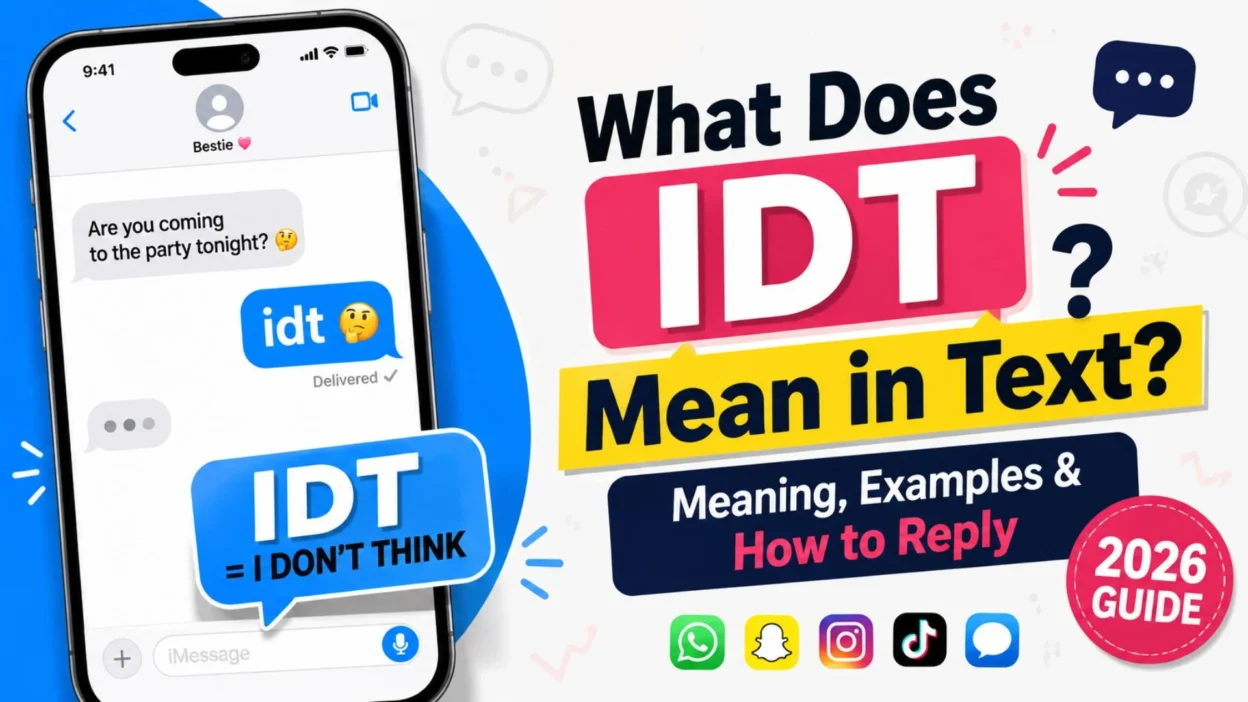
In most casual conversations, IDT means “I don’t think.” People use it when they are unsure about something, disagree with an idea, or want to give a quick opinion without typing the whole phrase.
For example, if someone asks, “Do you think Sarah is coming tonight?”, a reply like “idt” usually means “I don’t think so.”
However, the exact tone can change depending on the conversation. It might sound uncertain, casual, playful, or slightly negative.
In this guide, you’ll learn exactly what IDT means in text, how people use it, what it means on social media, how to reply, and how it differs from similar abbreviations such as IDK.
What Does IDT Mean in Text?
IDT usually means “I don’t think” in texting and online conversations.
It is an informal abbreviation used to express doubt, uncertainty, or disagreement. People commonly use it in quick messages because typing three letters is faster than writing the complete phrase.
For example:
Person 1: “Will they finish the project today?”
Person 2: “idt”
Here, “idt” means:
“I don’t think they will.”
The phrase is often followed by another word or sentence that gives more information.
Examples include:
- idt so = I don’t think so
- idt it will work = I don’t think it will work
- idt he knows = I don’t think he knows
- idt that’s right = I don’t think that’s right
- idt we should go = I don’t think we should go
So, if you see IDT in a normal text conversation, the safest interpretation is usually “I don’t think.”
What Does “IDT” Stand For?
IDT stands for:
I Don’t Think
It is created from the first letters of the three words:
- I = I
- D = Don’t
- T = Think
Unlike some slang terms that can have several completely different meanings, IDT is usually straightforward when it appears in casual texting.
For example:
“idt this is going to happen.”
The meaning is:
“I don’t think this is going to happen.”
The person is expressing an opinion or doubt rather than saying they have no idea.
IDT Meaning in Different Texting Situations
The meaning of IDT becomes easier to understand when you look at the situation around it.
1. IDT Means “I Don’t Think So”
This is one of the most common ways people use IDT.
Example:
You: “Are you going to the party tonight?”
Friend: “idt”
The person probably means:
“I don’t think so.”
They may not have made a final decision, so the reply does not necessarily mean a definite “no.”
2. IDT Can Show Uncertainty
Sometimes a person uses IDT because they are not completely sure.
Example:
You: “Is the store still open?”
Friend: “idt, it closes pretty early.”
Here, the person is making an educated guess rather than giving a definite answer.
This is why context matters when interpreting short slang.
3. IDT Can Express Disagreement
IDT can also be a softer way of disagreeing.
Example:
You: “That was the best movie this year.”
Friend: “idt 😂”
The person is basically saying:
“I don’t think so.”
The emoji can make the disagreement feel playful rather than serious.
4. IDT Can Give a Personal Opinion
A person may use IDT when responding to a question about their opinion.
Example:
You: “Do you think this phone is worth buying?”
Friend: “idt for that price.”
Meaning:
“I don’t think it is worth buying for that price.”
Here, IDT introduces a personal judgment.
IDT Meaning on Snapchat, Instagram, TikTok, and WhatsApp
You may see IDT on many different messaging platforms, including Snapchat, Instagram DMs, TikTok messages, WhatsApp, Discord, and regular text messages.
The meaning generally remains the same: “I don’t think.”
IDT on Snapchat
Snapchat conversations are often fast and informal, so abbreviations are common.
Example:
“idt you can beat my score 😂”
This means:
“I don’t think you can beat my score.”
Depending on the emoji or previous messages, it could be serious or playful.
IDT on Instagram
On Instagram, someone might use IDT when responding to a Story, Reel, comment, or direct message.
Example:
“idt that outfit works tbh”
This means:
“I don’t think that outfit works, to be honest.”
The phrase can sound more direct because there is little additional context.
IDT on TikTok
TikTok conversations often use short-form slang.
Example:
“idt this trend is coming back”
The person is saying:
“I don’t think this trend is coming back.”
IDT on WhatsApp
WhatsApp users may use IDT in both one-on-one chats and group conversations.
Example:
A: “Are we meeting at 8?”
B: “idt, wasn’t it 9?”
Here, IDT signals uncertainty and invites clarification.
Is IDT Rude?
IDT is not automatically rude.
The tone depends heavily on the surrounding conversation.
A simple “idt” can sometimes feel blunt because it is so short. However, the abbreviation itself is not offensive.
Compare these examples:
“idt 😂”
This may feel playful.
“idt.”
This may feel more serious or dismissive.
“idt, but I could be wrong.”
This sounds thoughtful and uncertain.
So, punctuation, emojis, previous messages, and the relationship between the people can all affect how IDT feels.
Is IDT a Negative or Positive Expression?
IDT is usually neutral to slightly negative because it often introduces doubt or disagreement.
However, it is not necessarily an insult.
For example:
“idt it’s going to rain.”
This is simply an opinion.
On the other hand:
“idt you’re right.”
This clearly disagrees with someone.
The emotional meaning depends on what comes after IDT.
Does IDT Mean “I Don’t Know”?
No.
This is one of the most common mistakes people make.
IDT = I don’t think
IDK = I don’t know
They communicate different ideas.
IDT Example
Question: “Do you think Jake will come?”
Answer: “idt.”
Meaning:
“I don’t think so.”
The person is giving an opinion or prediction.
IDK Example
Question: “Is Jake coming?”
Answer: “idk.”
Meaning:
“I don’t know.”
The person does not have enough information to answer.
IDT vs. IDK
| Slang | Meaning | Main Idea |
|---|---|---|
| IDT | I don’t think | Opinion or doubt |
| IDK | I don’t know | Lack of knowledge |
A simple way to remember it is:
IDK = I have no information.
IDT = Here is what I think.
IDT vs. “I Don’t Think So”
There is also a small difference between using IDT alone and using “I don’t think so.”
When someone sends only:
“idt”
They may be shortening the entire response.
For example:
“Are you coming?”
“idt.”
This can naturally be read as:
“I don’t think so.”
But when IDT appears before another phrase, it works more like the beginning of a sentence.
Examples:
- “idt he will come”
- “idt that’s true”
- “idt we need it”
- “idt this is enough”
In all of these cases, the person is introducing their opinion.
How People Use IDT in Real Conversations
Understanding realistic examples is one of the easiest ways to learn texting slang.
With Friends
Friend: “You think we can finish this tonight?”
You: “idt 😂”
Meaning:
“I don’t think we can.”
During a Debate
Person A: “Everyone loves that show.”
Person B: “idt everyone does.”
This is a casual disagreement.
While Making Plans
A: “Can we meet at 6?”
B: “idt, I’ll still be working.”
Here, IDT means the proposed time probably does not work.
Talking About School or Work
A: “Will the teacher accept this tomorrow?”
B: “idt. The deadline was today.”
The person is expressing doubt based on what they know.
In Gaming
Player 1: “Should we attack now?”
Player 2: “idt, wait for them.”
Here, IDT means the player does not think attacking immediately is a good idea.
In a Relationship Conversation
Partner: “Do you think we should talk about this now?”
Reply: “idt. Maybe we both need some time.”
In this situation, IDT is more serious and should be interpreted from the full conversation rather than the abbreviation alone.
How to Reply When Someone Says “IDT”
Your best response depends on what the person means.
If they simply say “idt,” you can ask for clarification.
Casual Responses
- “Fair enough.”
- “Okay 😂”
- “Gotcha.”
- “Why not?”
- “I see.”
If You Want More Details
- “Why do you think that?”
- “What makes you say that?”
- “Really? Why?”
- “What happened?”
Playful Responses
- “That sounds like a challenge 😏”
- “We’ll see about that 😂”
- “You’re underestimating me.”
- “Bet. Watch me prove you wrong.”
If the Conversation Is Serious
Instead of joking, try:
- “Can you explain what you mean?”
- “What makes you unsure?”
- “I understand. Let’s talk about it.”
The best reply is one that matches the tone of the conversation.
Can IDT Be Used in Flirting?
Yes, IDT can appear in playful or flirty conversations.
The abbreviation itself is not inherently romantic, but the surrounding message can make it teasing or flirtatious.
For example:
You: “I bet you’re thinking about me.”
Them: “idt 😏”
The response could be playful denial rather than a serious disagreement.
Another example:
You: “I can definitely beat you at bowling.”
Them: “idt 😉”
Here, IDT may be part of friendly flirting or teasing.
The important thing is not to assume romantic interest just because someone uses IDT. The rest of the conversation provides the real context.
When Should You Avoid Using IDT?
IDT is useful in casual conversations, but it is not appropriate everywhere.
Professional Emails
Avoid writing:
“idt this will work.”
Instead, write:
“I don’t think this approach will work.”
A complete sentence sounds clearer and more professional.
Formal Messages
If you are contacting a client, teacher, manager, customer, or professional organization, avoid unnecessary slang.
Clear language reduces the chance of misunderstanding.
Serious Conversations
If someone is discussing an important personal issue, a one-word response like “idt” can seem dismissive.
Instead of:
“idt”
Try:
“I don’t think that would be the best option, but I understand where you’re coming from.”
The second version communicates your opinion while showing respect.
Why Do People Use IDT Instead of Writing the Full Phrase?
The main reason is speed and convenience.
Texting culture has made short abbreviations common because people often want to respond quickly.
Compare:
“I don’t think so.”
with:
“idt.”
The second version is much faster.
People also use abbreviations because they fit the informal style of texting. On social platforms, users often communicate with a mixture of slang, emojis, shortened words, and acronyms.
That does not mean every person will use IDT. Slang preferences vary by age, platform, friend group, and region.
Common Mistakes When Reading IDT
Short messages can easily be misunderstood.
Mistake 1: Assuming It Means “No”
IDT can indicate doubt, but it does not always mean a firm rejection.
“idt, maybe later.”
This leaves room for another possibility.
Mistake 2: Confusing IDT With IDK
Remember:
IDT = I don’t think
IDK = I don’t know
Mistake 3: Assuming the Person Is Angry
A short response can look cold, but the person may simply be typing quickly.
Look at the larger conversation before deciding what they mean emotionally.
Mistake 4: Ignoring Context
The sentence around IDT can completely change the meaning.
“idt you should do that.”
is different from:
“idt lol.”
The first sounds like advice or disagreement. The second may simply be playful.
Other Texting Abbreviations Related to IDT
If you are learning modern texting slang, these abbreviations are also useful:
- IDK — I don’t know
- IMO — In my opinion
- IMHO — In my humble opinion
- TBH — To be honest
- TBF — To be fair
- FR — For real
- NGL — Not gonna lie
- NVM — Never mind
- BTW — By the way
- FYI — For your information
- IKR — I know, right?
- SMH — Shaking my head
Learning these terms can make social media conversations much easier to understand.
Is “IDT” Still Used in 2026?
Yes. IDT can still be found in informal texting and online conversations in 2026, although slang usage changes quickly.
Not every person uses the abbreviation, and some people prefer newer expressions or simply write the full phrase.
That is normal. Internet slang is not a fixed dictionary. Words and abbreviations can become popular, decline, or change meaning over time.
If someone uses IDT in a message today, context remains the best way to understand what they intended.
Frequently Asked Questions About IDT
What does IDT mean in text?
IDT usually means “I don’t think.” It is used in casual messages to express doubt, uncertainty, or disagreement.
What does IDT mean on Snapchat?
On Snapchat, IDT generally means “I don’t think.” For example, “idt you can beat me” means “I don’t think you can beat me.”
What does IDT mean on Instagram?
IDT has the same common meaning on Instagram: “I don’t think.” It may appear in DMs, comments, or casual conversations.
Is IDT the same as IDK?
No. IDT means “I don’t think,” while IDK means “I don’t know.” IDT usually expresses an opinion or doubt, while IDK indicates that someone does not have the information.
Is IDT rude?
Not necessarily. IDT is normally neutral, but a very short reply can sometimes sound blunt depending on the conversation.
How should I respond to IDT?
You can respond with “Fair enough,” “Why do you think that?” or “What makes you say that?” Choose a response based on the tone and subject of the conversation.
Can IDT be used in formal writing?
It is better to avoid IDT in professional or formal communication. Write “I don’t think” instead so your meaning is immediately clear.
Does IDT always mean disagreement?
No. It can express disagreement, but it can also show uncertainty or a personal opinion.
Can IDT be used in a flirty conversation?
Yes. IDT can appear in playful or teasing conversations, including flirting. However, the abbreviation itself does not automatically indicate romantic interest.
Why do people use IDT?
People use IDT because it is short, quick, and convenient for casual online conversations.
Final Takeaway
So, what does IDT mean in text?
In most casual conversations, IDT means “I don’t think.” It is commonly used to express an opinion, uncertainty, doubt, or a soft disagreement.
If someone texts “idt,” they usually mean something like “I don’t think so.” The exact tone depends on the surrounding conversation, punctuation, emojis, and relationship between the people involved.
The easiest way to remember it is:
IDT = I Don’t Think
IDK = I Don’t Know
Once you understand that difference, IDT becomes much easier to recognize in texts, DMs, social media conversations, and everyday online chats.

Awais Bilal is the Author of Blessingera, a website dedicated to sharing inspiring blessings, prayers, and positive messages for everyday life.