Have you ever received a message like “TF?”, “Why TF are you doing that?”, or “How TF did this happen?” and wondered what the person meant?
If so, you’re not alone. TF is a common internet abbreviation used in texts, DMs, comments, gaming chats, and social media conversations. Its meaning is usually easy to understand once you look at the context, but the tone can change depending on how it is used.
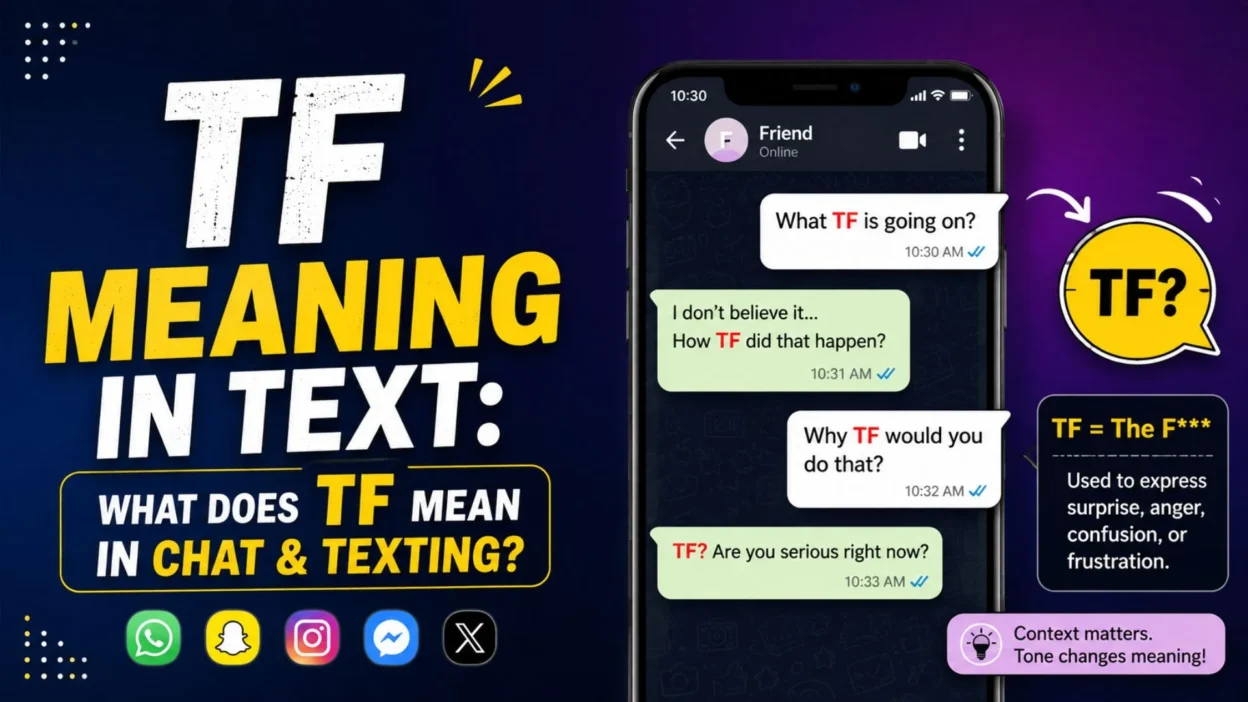
In most casual conversations, TF is a shortened form of “the f*.”** The abbreviation is often used to add strong emotion to a sentence. Depending on the situation, that emotion can be surprise, confusion, frustration, disbelief, excitement, or even humor.
For example:
- “What TF is happening?” — strong confusion or surprise
- “How TF did you do that?” — disbelief or amazement
- “Why TF are you late?” — frustration or annoyance
- “Who TF told you that?” — surprise or irritation
- “TF? 😂” — shock or humorous disbelief
Because TF contains an implied swear word, it is generally considered informal slang. It works naturally in casual conversations but may be inappropriate in professional or formal communication.
Let’s break down the TF meaning in text, how people use it, and what you should know before using it yourself.
What Does TF Mean in Text?
The most common TF meaning in text is “the f*.”**
It is not usually used as a complete phrase by itself. Instead, TF is inserted into a sentence to make the emotion stronger.
For instance:
“Why did you leave?”
is a straightforward question.
But:
“Why TF did you leave?”
sounds much more emotional. The speaker could be confused, annoyed, shocked, or joking depending on the relationship and situation.
The abbreviation allows people to communicate a strong reaction without typing the entire profanity.
TF Is Mainly Used for Emphasis
One of the simplest ways to understand TF is to think of it as an emotional intensifier.
Compare these examples:
- “How did you know?”
- “How TF did you know?”
The second sentence carries considerably more emotion.
However, the exact emotion isn’t fixed. Context determines whether the sender sounds angry, amazed, confused, playful, or simply surprised.
What Is the Full Form of TF in Chat?
The most common TF full form in chat is “the f*.”**
It is related to other internet abbreviations that contain the same profanity, including:
- WTF — What the f***
- WTH — What the heck / What the hell
- AF — As f***
- STFU — Shut the f*** up
TF itself is often placed after words such as what, why, how, who, and where.
Examples include:
- What TF?
- Why TF?
- How TF?
- Who TF?
- Where TF?
These expressions are common in informal online conversations.
What Does “TF?” Mean by Itself?
When someone sends only “TF?”, the meaning usually depends on what happened immediately before it.
It can communicate:
- “What the f***?”
- “What is going on?”
- “Are you serious?”
- “What was that?”
- “Why did you do that?”
For example:
Person A: I sold my car and bought a motorcycle today.
Person B: TF? 😭
Here, “TF?” probably expresses surprise rather than serious anger.
Another example:
Person A: I accidentally deleted the entire project.
Person B: TF?!
In this situation, the sender is likely shocked by the news.
So, TF by itself is more of a reaction than a precise sentence.
TF Meaning Depends on Context
One important thing to remember is that TF doesn’t communicate exactly the same emotion every time.
TF Can Show Surprise
Someone might use TF after hearing unexpected news.
Example:
“You met Taylor Swift yesterday?”
“TF?! No way!”
The abbreviation emphasizes disbelief and surprise.
TF Can Show Confusion
It can also indicate that someone doesn’t understand a situation.
Example:
“How TF does this new update work?”
Here, the person is confused and possibly frustrated.
TF Can Show Frustration
When something goes wrong, TF may express annoyance.
Example:
“Why TF did the app log me out again?”
The sender is clearly frustrated with the situation.
TF Can Show Disbelief
Someone might use TF when they find something difficult to believe.
Example:
“He finished the entire assignment in twenty minutes.”
“How TF?”
This communicates amazement or disbelief.
TF Can Be Used Humorously
Friends also use TF jokingly when reacting to funny or ridiculous situations.
Example:
“I just watched my cat steal a slice of pizza.”
“TF 😂”
The sender probably isn’t angry. They’re simply reacting dramatically for comedic effect.
Common Ways People Use TF in Text Messages
The abbreviation appears in several sentence patterns.
“What TF”
This is one of the most recognizable forms.
Examples:
- “What TF is that?”
- “What TF happened?”
- “What TF are you talking about?”
It usually expresses confusion, surprise, or disbelief.
“Why TF”
This form often communicates frustration.
Examples:
- “Why TF did you cancel?”
- “Why TF is this taking so long?”
- “Why TF would anyone do that?”
The tone can be serious or playful.
“How TF”
This expression commonly indicates amazement or confusion.
Examples:
- “How TF did you get here so quickly?”
- “How TF did you solve that?”
- “How TF does this even work?”
“Who TF”
This is usually used when the identity of someone is surprising or unknown.
Examples:
- “Who TF is calling me?”
- “Who TF told you that?”
- “Who TF made this?”
“Where TF”
This can express impatience, confusion, or surprise.
Examples:
- “Where TF are you?”
- “Where TF did my phone go?”
- “Where TF did everyone disappear?”
TF Meaning on Social Media
TF is not limited to private text messages. You can also see it across social media platforms.
It frequently appears in:
- Instagram comments
- TikTok comments
- Snapchat messages
- Facebook posts
- X conversations
- Reddit discussions
- Discord chats
- Gaming communities
The basic meaning generally stays the same, but the tone depends heavily on the post and conversation.
For example, someone commenting:
“How TF is this video so good?”
may be complimenting the creator rather than criticizing them.
That’s why reading the whole sentence and surrounding conversation is important.
What Does TF Mean on Snapchat?
On Snapchat, TF usually has the same slang meaning: “the f*.”**
Because Snapchat is primarily associated with casual communication, friends may use TF freely in:
- Snaps
- Chat messages
- Story replies
- Group conversations
For example:
“Why TF are you awake at 4 AM?”
Depending on the relationship, this could sound concerned, surprised, or playful.
Another example:
“TF 😂 that filter is wild.”
Here, the abbreviation adds a humorous reaction.
What Does TF Mean on Instagram?
On Instagram, TF can appear in both private and public interactions.
You might see it in:
- DMs
- Reel comments
- Story replies
- Post comments
For example:
“Why TF does this outfit look so good?”
This probably isn’t an angry statement. It may simply express admiration or surprise.
Likewise:
“What TF is going on in this comment section?”
could communicate confusion about a chaotic discussion.
What Does TF Mean on WhatsApp?
WhatsApp users often use TF in casual one-to-one conversations and group chats.
For example:
Friend: I forgot the tickets at home.
You: TF 😭
Or:
“Why TF didn’t you tell me earlier?”
Among close friends, this can sound natural and conversational.
However, using TF in a work-related WhatsApp group could make your message appear unnecessarily casual or unprofessional.
TF Meaning in Gaming
Gamers frequently use short abbreviations because conversations happen quickly.
TF can appear in:
- In-game chats
- Discord servers
- Gaming forums
- Voice-chat messages
For example:
“Who TF started the boss fight?”
or:
“How TF did they get behind us?”
The abbreviation can express frustration, surprise, or excitement.
Gaming communities also have their own meanings for TF in certain contexts, so the surrounding conversation matters.
Is TF a Bad Word?
TF is considered profanity-based slang because it represents a phrase containing a strong swear word.
That doesn’t necessarily mean every use is intended to offend someone.
For example:
“How TF did you do that?”
could be an excited compliment between friends.
But:
“Why TF did you do that?”
could sound aggressive when directed at someone during an argument.
So, the tone and relationship between the people involved matter just as much as the abbreviation itself.
Is TF Rude?
TF can be rude, but it isn’t automatically rude.
Consider these two situations.
Friendly Use
Friend: I finally passed my driving test!
You: How TF did you do it on your first try? 😂
This is likely playful and positive.
Aggressive Use
Coworker: I changed the file because the previous version was incorrect.
You: Why TF did you change it?
This could sound disrespectful and confrontational.
The words around TF determine much of the tone.
When Should You Avoid Using TF?
Because TF is based on profanity, it is better to avoid it in formal situations.
Avoid using it in:
- Job applications
- Business emails
- Formal reports
- Academic assignments
- Customer support messages
- Professional presentations
- Conversations with people you don’t know well
Instead, use neutral alternatives.
For example:
Informal:
“What TF happened?”
Neutral:
“What happened?”
Informal:
“How TF did you do that?”
Neutral:
“How did you do that?”
Informal:
“Why TF is this broken?”
Neutral:
“Why isn’t this working?”
TF vs. WTF: What’s the Difference?
TF and WTF are related, but they aren’t used in exactly the same way.
| Slang | Common Meaning | Typical Use |
|---|---|---|
| TF | The f*** | Added emphasis inside a sentence |
| WTF | What the f*** | Complete reaction or question |
| WTH | What the heck / hell | Milder reaction |
| AF | As f*** | Adds emphasis to an adjective |
| IDK | I don’t know | Shows uncertainty |
| OMG | Oh my God | Shows surprise or excitement |
For example:
“WTF?”
is a complete reaction.
Meanwhile:
“Why TF are you here?”
uses TF inside a question.
What Does TF Mean in Different Situations?
Here’s a quick way to understand its possible meanings:
| Situation | Likely Meaning |
|---|---|
| “TF?” | Shock, confusion, or disbelief |
| “What TF?” | Confusion or surprise |
| “Why TF?” | Frustration or disbelief |
| “How TF?” | Amazement or confusion |
| “Who TF?” | Surprise or irritation |
| “Where TF?” | Confusion or impatience |
| “TF 😂” | Humorous surprise |
| “TF is this?” | Confusion or disbelief |
These aren’t strict definitions. The sender’s tone and the conversation always matter.
Other Meanings of TF
Although “the f*” is the dominant meaning in texting**, TF can have other meanings in specific communities.
For example:
Team Fortress
In gaming, TF may refer to Team Fortress, particularly when discussing the Team Fortress game series.
Task Force
In business, government, military, or organizational contexts, TF may be shorthand for task force.
For example:
“The TF will meet tomorrow.”
Transfer
In certain professional or financial contexts, TF may be used as an abbreviation for transfer, although this isn’t standard everywhere.
Too Funny
Some people may use TF to mean too funny, but this interpretation is much less common than the profanity-based meaning.
This is why context is essential. If you’re reading TF in a gaming document, workplace message, or technical discussion, don’t automatically assume it means “the f***.”
How to Respond When Someone Says TF?
Your response should depend on the sender’s apparent tone.
If They’re Confused
If someone says:
“TF is this?”
You can respond:
“Haha, let me explain.”
If They’re Surprised
If they say:
“TF?! You actually won?”
You could reply:
“Yep! I still can’t believe it either.”
If They’re Angry
If someone says:
“Why TF did you cancel?”
A calm response is usually better:
“Sorry about that. Something unexpected came up.”
If They’re Joking
If the conversation is clearly playful:
“TF 😂”
You can simply match the humor:
“I know 😂”
How to Understand TF Without Misreading the Tone
Text messages don’t include facial expressions or voice tone, which can make slang difficult to interpret.
Before assuming someone is angry, consider:
- What happened before the message?
- Are you close friends?
- Did they use emojis?
- Is the conversation normally sarcastic?
- Are they actually complaining about something?
For example, “How TF did you win?” could be genuine admiration between friends. The exact same words could sound annoyed in another conversation.
Why Do People Use TF Instead of the Full Phrase?
There are several reasons.
It Is Faster
Short abbreviations make texting quicker.
It Adds Emotional Weight
TF makes an otherwise ordinary question sound more dramatic.
It Fits Internet Culture
Online conversations often rely on abbreviations, memes, slang, and shortened expressions.
It Can Feel Less Explicit
Writing TF instead of spelling out the profanity can feel slightly less direct while still communicating the intended emotion.
It Makes Reactions More Expressive
A short message such as:
“TF 😭”
can communicate a surprisingly strong reaction without a long explanation.
Examples of TF in Everyday Texting
Here are some natural examples:
- “What TF is happening?”
- “Why TF are you laughing?”
- “How TF did you find me?”
- “Who TF sent this?”
- “Where TF did everyone go?”
- “TF was that?”
- “How TF is that possible?”
- “Why TF is my internet so slow?”
- “Who TF thought this was a good idea?”
- “TF 😂 I can’t believe you actually did it.”
The meaning in each example comes from the context rather than from TF alone.
Frequently Asked Questions About TF Meaning in Text
What does TF stand for in texting?
In casual texting, TF usually stands for “the f*.”** It is used to add emphasis to questions, reactions, or statements.
What does TF mean in chat?
TF meaning in chat is usually an informal expression of surprise, confusion, frustration, disbelief, or emphasis. The exact emotion depends on the context.
What does “TF?” mean?
“TF?” is generally a short reaction meaning something similar to “What the f*?”** It can indicate surprise, confusion, disbelief, or amusement.
Is TF the same as WTF?
Not quite. WTF generally means “what the f***” and often works as a complete reaction. TF is commonly placed inside a sentence, such as “Why TF are you here?”
What does TF mean on Snapchat?
On Snapchat, TF usually has the same meaning as in other casual chats: “the f*.”** It is commonly used to express strong reactions among friends.
What does TF mean on Instagram?
On Instagram, TF is commonly used in DMs, comments, and story replies to express surprise, confusion, excitement, or frustration.
Can TF be used professionally?
It is best avoided in professional communication. Since it represents profanity, it may appear rude or inappropriate in emails, workplace chats, academic writing, and formal messages.
Does TF always mean “the f***”?
No. In specialized contexts, TF can mean other things such as Team Fortress or task force. Context determines the intended meaning.
Is TF offensive?
It can be. Although many people use it casually among friends, TF is based on profanity and may be considered offensive or inappropriate in formal situations.
Final Thoughts on TF Meaning in Text
The most common TF meaning in text is “the f*,”** an informal abbreviation used to add emotional emphasis to digital conversations.
You may see it in phrases such as “What TF,” “Why TF,” “How TF,” “Who TF,” and “Where TF.” Depending on the conversation, it can communicate surprise, confusion, frustration, disbelief, excitement, or humor.
The key is to look beyond the abbreviation itself. A message like “TF?” from a close friend may simply be a funny reaction, while the same expression from an angry coworker could feel confrontational.
So, if you see TF in a text, don’t automatically assume the sender is angry. Context, relationship, punctuation, emojis, and the surrounding conversation all help reveal the intended tone.
And because TF is profanity-based slang, keep it to casual settings where you know the language will be understood appropriately.

Awais Bilal is the Author of Blessingera, a website dedicated to sharing inspiring blessings, prayers, and positive messages for everyday life.